
Search Dunn County Death Records
Dunn County Death Records are usually best handled by starting with the county Register of Deeds and then moving outward only if the local trail is thin. The research for Dunn County is narrow, but it still gives a clear local point. Dunn County Register of Deeds issues certified copies of birth, death, and marriage certificates for events that occurred within Dunn County, Wisconsin. That makes the county office the most direct place to begin when you already know the person, the year, or the town clue. If the date is old or the name is incomplete, state resources and historical guides can help narrow the search before you ask for a copy.
Dunn County Office
The county office is the cleanest local anchor for Dunn County Death Records because the research source names the Register of Deeds as the place that issues certified copies. That is enough to make the office path practical even when the rest of the research is sparse. A county office that already handles birth, death, and marriage certificates tends to be the right first stop for a death search, especially when the record is recent or the family already knows the county of death. If the request is for a certified copy, the county role matters more than any broad statewide summary.
The Dunn County government website gives this page its local anchor, and the image below points back to the same county source.
That image keeps Dunn County Death Records tied to the office that actually serves the county record path.
The Wisconsin Department of Health Services page at DHS Vital Records is the statewide fallback image source for Dunn County Death Records.
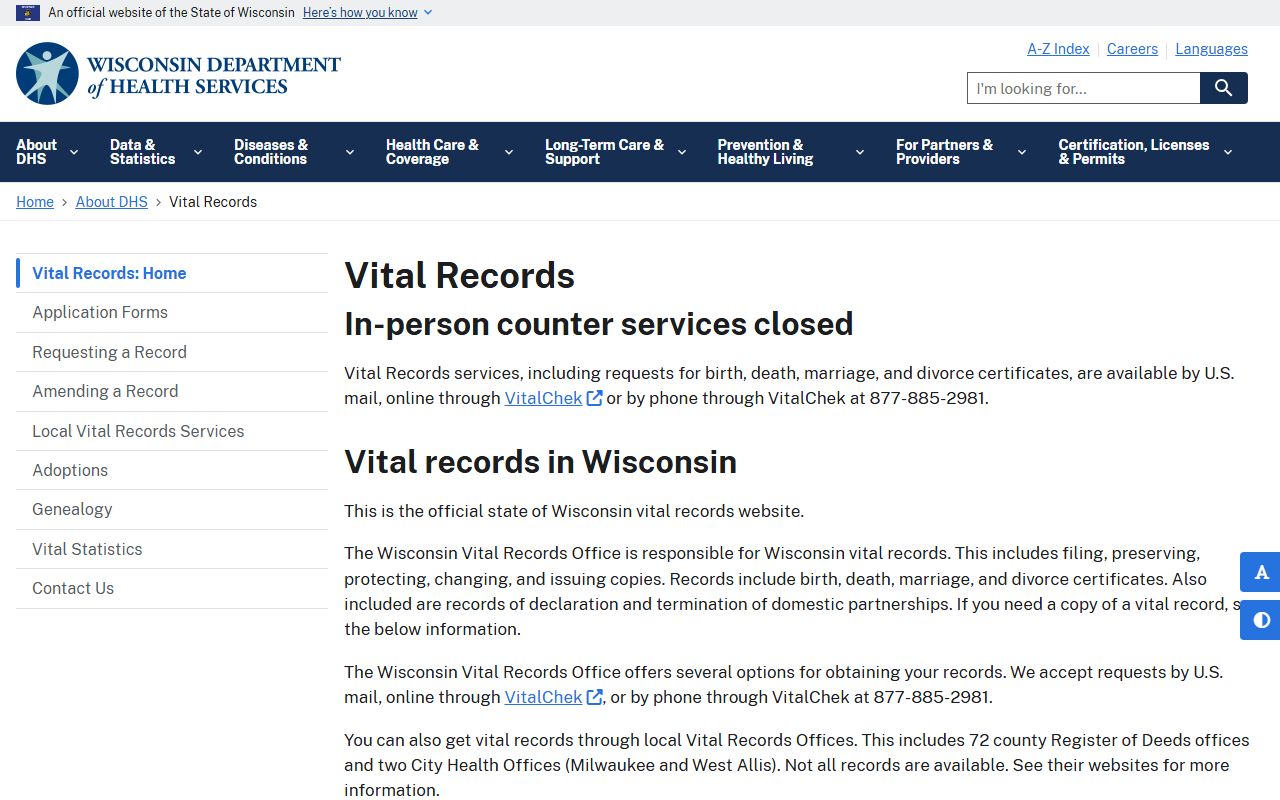
That image gives the page a broader Wisconsin anchor when the county trail is thin.
Because the county research is thin, the safest way to read it is literally. The Register of Deeds is not presented as a generic records counter. It is the office that issues certified copies of the record types named in the source. That makes the search easier to explain and easier to trust. You do not need to invent a deeper local system when the county note already gives you the key fact. You only need to follow that fact into the state and historical tools when the death record is harder to pin down.
For a Dunn County researcher, the office question is usually simple. Is the record in the county system, or do you need a wider Wisconsin search? Once that is clear, the rest of the request becomes much more manageable.
Dunn County Death Records Search
After the county office, the next best step is the state fallback. The Wisconsin Department of Health Services vital records page at dhs.wisconsin.gov/vitalrecords/index.htm explains the statewide request path and gives Dunn County searchers a backup when the record is not easy to place locally. That matters when a family member only knows that the death happened in northwest Wisconsin, or when the exact date is fuzzy. The state office is useful because it is designed to handle the larger Wisconsin record system, and Dunn County sits inside that system even when the local office is the first stop.
The CDC's Wisconsin guidance at cdc.gov/nchs/w2w/wisconsin.htm helps set the statewide frame. It confirms the October 1907 registration line that separates older records from the modern system. That line is important in Dunn County because it tells you when a search may need to shift from a copy request to a history search. If the death is recent, the county office is usually the better route. If the death is older, the state guidance becomes more useful because the record may not sit in the same way in the local system.
The Wisconsin Historical Society pages at CS88 and CS1581 are the best archive tools to keep nearby. CS88 explains pre-1907 record searching, and CS1581 shows what a death record can contain once you find it. Those pages are practical for Dunn County because a person may have lived or died in the county long before the modern request path was standardized. A name, a place, and a rough year can often be enough to move from a family story to a likely record entry.
If you are still unsure where to start, the safest sequence is county, state, then history. That sequence matches the way the sources are built. It also prevents a vague request from bouncing between offices that are all part of the same Wisconsin death records network.
Dunn County History
Dunn County history is less about a long office narrative and more about knowing where the record sits inside Wisconsin's broader vital records system. That is useful because the local research note does not try to describe a full county archive. Instead, it tells you exactly what the county office does now. That keeps the page honest. It also means the historical tools have to do more of the work when the death is older or the request needs context before a certified copy can be ordered.
The Wisconsin Historical Society page at CS88 is especially helpful for that older work because it shows how pre-1907 death records can be approached. Dunn County researchers often need that kind of help when a family line runs back beyond the modern office records. If the surname is common, or if the town clue is broad, a historical index can be the quickest way to separate one person from another. That is often faster than asking the county office to search blindly.
The companion history page at CS1581 explains what a death record can show once it is located. That matters because the value of a record is not just the death date. A record can hold names, places, and other clues that point to the next file. In Dunn County, those clues are often what connect a county certificate to a larger family story. A clean copy request may be the goal, but the historical details can be the thing that makes the request accurate.
When the local research is thin, it is better to keep the language careful than to fill space with guesses. Dunn County Death Records still fit the Wisconsin system. They just require a search path that respects the limits of the available county source and uses the state and archive pages where they are strongest.
Note: Dunn County Death Records are easiest to manage when the county office fact, the 1907 state line, and the historical index are used together instead of treated as separate systems.
Dunn County Death Records Requests
Once you know where the record belongs, the request itself becomes straightforward. The Wisconsin Register of Deeds Association page at wrdaonline.org/vitalrecords gives the standard Wisconsin vital records pattern, which is useful when you want to understand how copy requests are normally handled across the state. That statewide pattern matters in Dunn County because the county office sits inside the same system. A certified copy request that names the person clearly, gives a rough date, and identifies the county is much easier to handle than a broad search with no place clue.
Wisconsin law helps define the copy path too. Wis. Stat. 69.21 covers copies of vital records, including who may receive certified copies and how offices manage them. Wis. Stat. 69.18 explains the death record format and the difference between the parts of the record. That is useful because many people do not know whether they need a fact-of-death copy, an extended copy, or a historical lead. The statute names the structure. The county office then uses that structure to handle the request.
Dunn County Death Records requests work best when the record type is decided before the search starts. If you only need proof that the death was recorded, the request can stay narrow. If you need a broader family history clue, the historical pages may be more useful before the county office issues the copy. That distinction saves time and avoids unnecessary back and forth. It also keeps the local and state sources in their proper roles.
The practical path is simple. Use the county Register of Deeds for the certified copy, use the state office when you need a statewide fallback, and use the historical society when the death is old enough to need an archive search first. That is the most reliable way to work with Dunn County Death Records without forcing the page to promise more than the research supports.